


Watch Out for Temu, and 8 Other Useful News Bites from the Global DIY-Summit

Updated: Jun 25
By Craig Webb
A record 1,204 people from 50+ countries traveled to Amsterdam June 17-19 for the biggest international meeting of companies that run home centers, hardware stores, and pro yards. Hardly any Americans attended the Global DIY-Summit, but I did, looking for stealable ideas. Here are nine takeaways that North America’s dealers can use.

Temu Is About to Launch a new Phase
Temu won't fade in America just because the U.S. government got rid of the de minimus tax exemption that enabled the Chinese online service to grow so dramatically, said Ed Sander, Digital Retail Analyst at China Digital Retail Report
The Temu that launched in the U.S. in September 2022 (and expanded to Europe later) actually was in just Phase 1 of a three-phase growth module, Sander says. That initial phrase began with Temu’s owner, PDD Holdings (which also owns Pinduoduo), taking products made by its 12 million merchants in China, putting them in its Chinese warehouses, and then flying the goods directly to customers in the U.S., thus avoiding import tariffs. The goal was fast penetration to get market share. The tactics were heavily subsidized prices and enormous ad budgets, plus games on the app.
Phase 2, which started in 2024, had the merchants export their products to warehouses in countries where the customers live. That cost them in tariffs, but for Temu it also made possible the sale of products that couldn’t be flown over on a plane. It’s why today you can buy on Temu goods as big as an excavator or a foldable house. Despite prices that are 30% cheaper on average than Amazon, and even with U.S. tariffs of 30% to 54%, in Phase 2 Temu can make a 2% profit. It expects to be globally profitable by the end of 2026.
Now comes Phase 3: Private-label products.
Xinpinmu is a private label brand being set up by Temu. It’ll be similar to Costco, Amazon Basics, and Shein, Sander said. It will start by collecting data from 540 million global users and sharing it with the 12 million merchant.
With that data, “They can tell manufacturers, ‘This is what you need to make,’” with high confidence that whatever is produced will sell, Sander said
The private-label effort will launch in the second half of this year with 4,000 SKUs, mostly apparel bags and daily necessities, with pricing that will produce a 10% loss. (PDD Holdings has $50 billion in cash reserves.) There will be three months of testing, a shakeout for the next three months, and then a full-scale rollout after month 6 with tens of thousands of SKUs.
“The main strength of this company, is the fact It’s directly linked to the 12 million companies in China. They can make anything,” Sander said. “New products can be launched in seven days.”
Temu’s ambition is to become Number 1 in the U.S. behind Amazon and Number 1 in Europe. Its private label goods are likely to fulfill the old line about Chinese goods: “80% of the quality at 50% of the cost.” Already in China, that promise is proving so alluring that companies like Samsung decided they can't compete and thus are pulling out of China entirely.
+++
Two Painful Timelines to Fear from the Iran War
Only about a month’s worth of oil reserves remain worldwide, so if the Straits of Hormuz stays essentially closed that long, prices “could skyrocket,” Ira Kalish, Deloitte’s Chief Global Economist, told the group, “We’re perched on a knife edge.”
While the potential cease-fire and opening of the Straits could help us avoid that disaster, a second problem is pretty likely to happen. That involves the shortage of fertilizer produced by Gulf countries that was stopped by the war. Less fertilizer means less robust crops, and fewer crops means we can expect food prices to rise six to 10 months from now. “In poor countries, that could be catastrophic,” Kalish said, while in wealthier countries, it’ll be an additional financial burden
+++

Revise Your CEO Title to “Change Executive Officer”
Intergamma is a Dutch-based, 370-store home center chain operating in an environment where “change is the only constant,” CEO Joost de Beijer said. That requires taking advantage of tech advances even as they evolve.
For instance, Intergamma’s website now has a chatbot that triples the conversion rate when customers use it. At the same time, the chatbot is helping the dealer identify the top questions and most-needed content that agentic agents will be looking for when they begin playing a bigger role in sales.
Intergamma also offers a wayfinder service in its stores that use geomagnetic fields to help guide customers to the exact aisle and bin where the product is located. That has boosted sales 2%, he said.
+++

Do it Best Shifts Branding Message to Rebuild True Value
Do it Best Group President & CEO Dan Starr said reviving the True Value brand actually meant introducing True Value to Millennials and Gen Z. And because those generations think of themselves differently than do Boomers and Gen Xers, Do it Best concluded it had to shift its branding message slightly.
The older generations identify with words like“Caregiver” and “Citizen,” research suggests, while the younger generations go more for “Creator” and “Rebel.”That insight influenced the “Your Project, Your Way” campaign for True Value launched about six months ago.
Starr also stressed that, despite the shift, the campaign fits in with Do it Best’s culture.
“Authenticity is a big issue for them. A sense of local is big. Buying local was important,” he said. “There are all things we can relate to and make our own.”
Click here for more on Starr’s session.
+++
An Underexploited Market for Home Improvement Sales?
Governments everywhere talk about making housing more affordable, and while they talk, home improvement manufacturers and dealers languish. Ken Hughes has an idea.
“We have to find a way to help renters spend on DIY,” he said.“The biggest thing that stops improvement in rental projects is fear of losing your deposit.” Thus, items like stick on wall appliqués should be sold as landlord-friendly. Hughes also thinks tool rentals and project-design spaces in apartment buildings would help boost home centers’ business.
+++

‘Make It Zero’ Initiative Targets Plastics in DIY
The manufacturing of DIY products worldwide generates 660 million tons of carbon dioxide every year—about the same as all of Canada produces. As one summit speaker put it, “We’re using the raw materials of three planets now, and it’s not sustainable.”
This is one of the reasons why 72 companies, including The Home Depot and Lowe’s, are part of the “Make It Zero” initiative, seeking to find ways to reduce greenhouse gas emissions.
Three years of work has largely focused on measuring the challenge and developing standards to cut CO2 emissions, not only in making products, but in handling them at home centers and then in the use of the products by end users, all the way to the end of the product’s life.
The initiative now has identified four products to work on first: Plastics, paint, ceramics, and steel. Of those, on June 18 the Initiative called for the plastics used in DIY products to be made of at least 35% recyclable materials by 2035. Doing so would cut emissions related to plastic products by 15%, or 6.3 metric tons of CO2.
+++
How to Fail Better
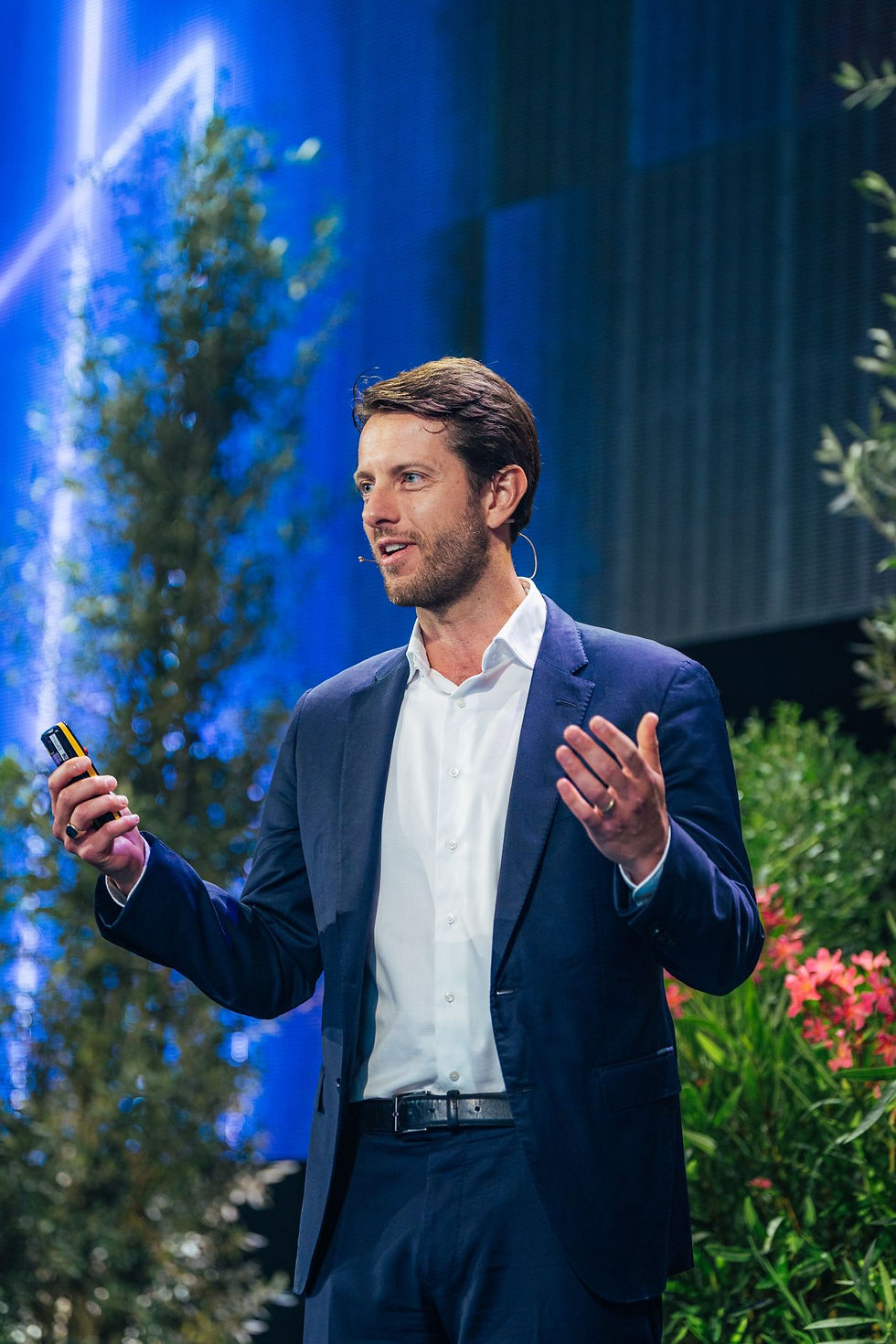
Building a world-class culture of innovation requires giving people time both to think and to fail, two speakers said.
It starts at the top, said Chris Heemskerk, Founder & CEO of The Innovation Alliance and a veteran of both Amazon and Google. CEOs that spend 99% “squeezing the lemon of their core business” aren’t leading by example, he said. “Leaders that lead for innovation spend 20% to 40% of their time on innovation and new hunting grounds they’re developing.” The goal, he said, is to be ambidextrous, both exploring and exploiting opportunities.
Raha Been, SVP for R&D and Commercialization at 3M, says her company uses an extensive data collection and analysis system when it explores how to innovate. She said one metric she uses with a team is how often it studies and then rejects an idea.
“I expect people to kill products, because it means they aren’t pushing hard enough,” she said. “Innovation isn’t necessarily about succeeding and failure. It’s about learning as you grow. … Failure is not necessarily a bad thing.”
Heemskerk said it’s important to celebrate misses as well as hits. Equally important, your company should want useful failures. At one company that used a penguin as a symbol, the business awarded a “Courageous Penguin Award” for a failure that was pursued intelligently. At Amazon, executives realized that an idea might not necessarily be bad, but rather was ill-timed or was being pitched to the wrong audience. So Amazon would have the idea’s advocate pitch the idea to multiple departments at the company, thinking that what was unsuitable in one branch of the company might be perfect in another.
The goal is to create a consistent, disciplined innovative culture, both Heemskerk and Been said. Create an innovation center. Give people space and time to share ideas, even if it’s only virtually. Be willing to accept friction between participants; it causes grit that can polish a rough idea. Give rewards for innovation. And make sure the CFO is willing to fund ideas.
+++

Why AI’s Arrival Will Mandate a Higher Level of Product Service
Good service brings you what customer experience guru Ken Hughes calls “transactional loyalty”—a benefit that appeals to the brain (and your wallet). But transactional loyalty shouldn’t be your end goal, he says. That’s because artificial intelligence “is going to commoditize customer experience so it will be amazing for everyone,” he said.
That’s why Hughes urged the DIY-Summit attendees to raise their game and win the customer’s heart. Adding empathy to your touchpoint in the customer’s journey will lead to preference loyalty, he said. For instance, when IKEA created a chatbot for its website, it found 53% of users got the answer they needed. That service was transactional. But for the other 47%, the answer desired wasn’t simple. Often it involved interior design, so IKEA retrained some of its phone support staff to become design specialists. Now they’re listening to individual customers, relating to their problems, and providing help. For those customers, IKEA is a company that appeals to the heart.
Here, AI can help. Imagine you sell materials for the bathroom You could have the customer upload a picture of their bathroom. Your AI system then could give the customer a set of ideas on how to renovate that space, along with lists of every product you would need and how-to-install-it videos customized to the customer’s actual bathroom.
But you can do even more.
Hughes says the peak type of relationship reaches the customer’s soul—giving each consumer a sense of belonging, meaning, and identity; the qualities that lead to attachment and advocacy. Taylor Swift has done this with her fans, going so far as to send some Christmas presents and, at minimum, looking directly into the eyes of fans during her concerts.
“When was the last time you made one of your customers cry—in a good way?,” Hughes asked, citing videos of Swifties getting teary-eyed while opening those presents from Taylor. In his home country of Ireland, Hughes says blood donors get a note from the blood-collecting service telling where and when their donated blood was used.
This brought Hughes back to AI. As we enter a world in which AI agents will do shopping
“People will have to know your brand now so they will call for it when they tell their agentic AI what to look for,” Hughes said.
+++

Save a Brick and Help the Planet
Amsterdam is so concerned about sustainability that the city has a Director of Innovation, Future-Proof Assets, and Climate Adaptation. That person, Sacha Stolp, said the work includes the lowly brick.
Amsterdam is a city of more than 5,000 brick streets, sidewalks, and bike paths. When it refurbishes a street, the city used to remove the bricks, crush them, and use them as low-value material. Now it uses machines to help collect the bricks as they are pulled off the street, and then organize them in containers to be sent and laid in other streets.
New bricks used to cost 3 Euros; now they cost 6. But recycling costs only 1 Euro per brick. and Amsterdam can re-use 1 million bricks a month. And on top of that, roughly 60% of the total emissions in a brick’s lifespan occurs when the raw materials are mined, the brick is fired, and the end result is trucked to a city. That 60% of emissions gets saved through re-use.
Amsterdam also has created a workshop to experiment with and test ideas for urban challenges. “Innovation doesn’t start with technology,” she said. “ It starts with collaboration between ideas on one side and new energy on the other.”
+++
The next Global DIY-Summit will take place June 2-4 in Prague, Czechia.


Comments